
Copying 13F trades? You're probably losing. Here's why.
It is not the famous 45-day lag, which costs roughly nothing. It is the leaks nobody prices, and the funds you chose to copy.

45 Days Late #2. Last time I rebuilt 2,681 smart-money portfolios and found that most lose to the index, winners do not stay winners, and only losing persists. Which kills the find-the-genius plan. But suppose you somehow did land on a good fund. This post is about what happens to the copy itself.
Every objection to 13F investing eventually arrives at the same place: the lag. By the time you see a filing, the positions are at least 45 days old. “You are buying someone’s stale homework” is the standard dismissal, and it sounds devastating.
I spent a week investigating this, and the standard dismissal turns out to be aimed at the wrong leak. The lag is nearly free. The expensive leaks are the ones nobody prices.
The lag, measured properly: almost nothing
Here is a clean way to isolate what staleness costs, with everything else held equal.
Take a fund’s disclosed book at the end of a quarter and measure its return over the next three months.
Now take the same fund’s book from one quarter earlier, the freshest thing a copier could legally hold, and run it over the same three months. Same market, same window, same manager; the only difference is that the copier’s version of the portfolio is one quarter old.
The return gap between the two is the pure price of staleness.
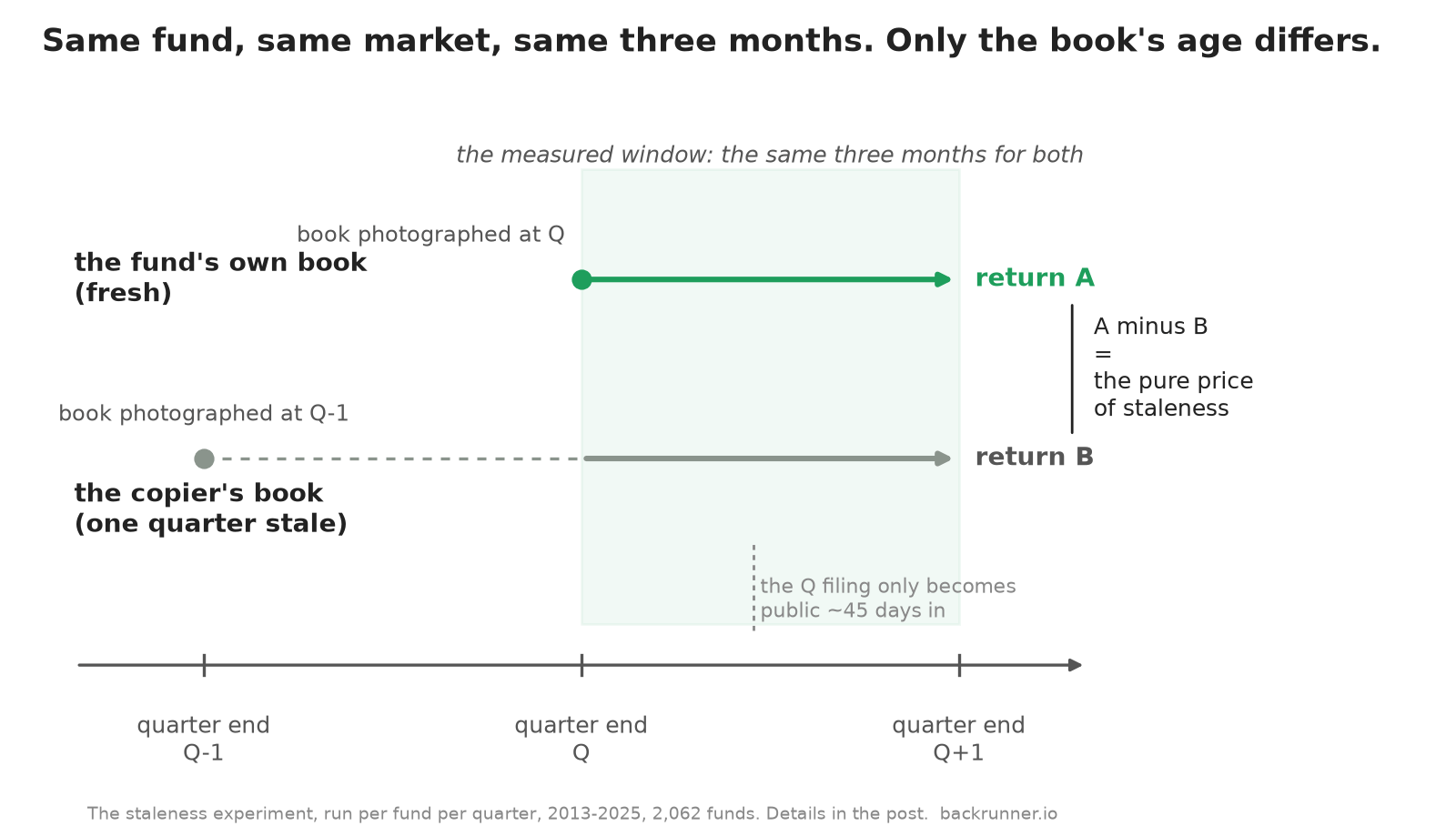
I ran that comparison for every fund in the reconstruction with at least three years of history: 2,062 funds, quarter by quarter, 2013 through 2025.
The median cost of holding the stale book is zero. Not small. Zero, to two decimal places, minus 0.00 points a year.
The average hides the real story, which is who pays:
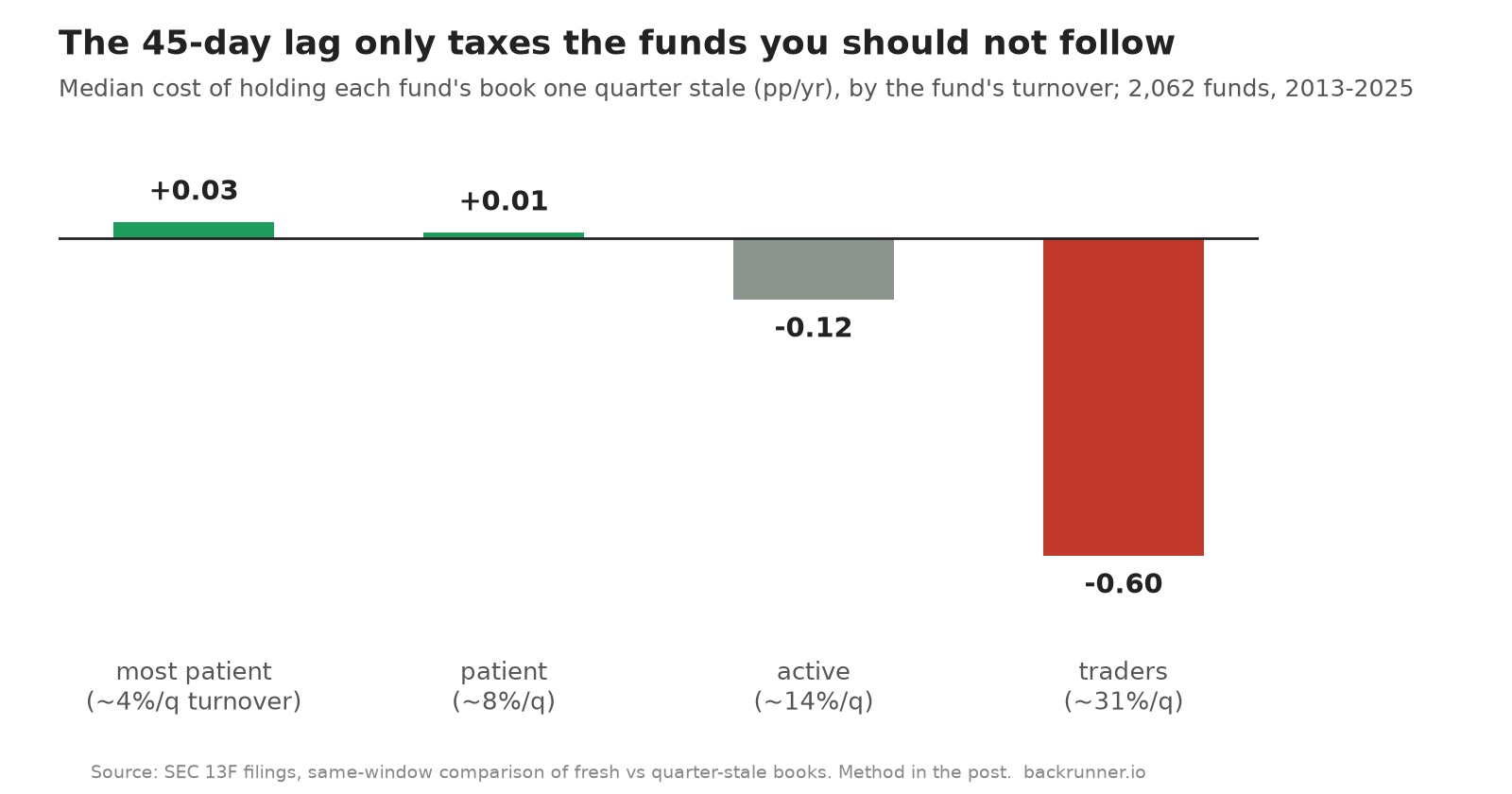
Sort the same funds by how much of their portfolio they replace each quarter and the lag’s tax turns monotonic.
The most patient quarter of funds, turning over about 4% of the book per quarter, pays nothing at all; the copy is effectively the fund.
The highest-turnover quarter, replacing about a third of the book every ninety days, pays around 0.6 points a year for the delay.
Let me be precise about what that last number means, because it is not “fast funds are bad funds.”
A 13F is a quarter-end photograph. For a patient manager the photograph and the film are nearly the same thing. For an active trader the photograph misses the movie: everything bought and sold inside the quarter, which for a fund replacing a third of its book every ninety days may be most of what the fund actually does. Their real performance lives in trades no filing will ever show. They might be brilliant. The filing cannot tell you either way.
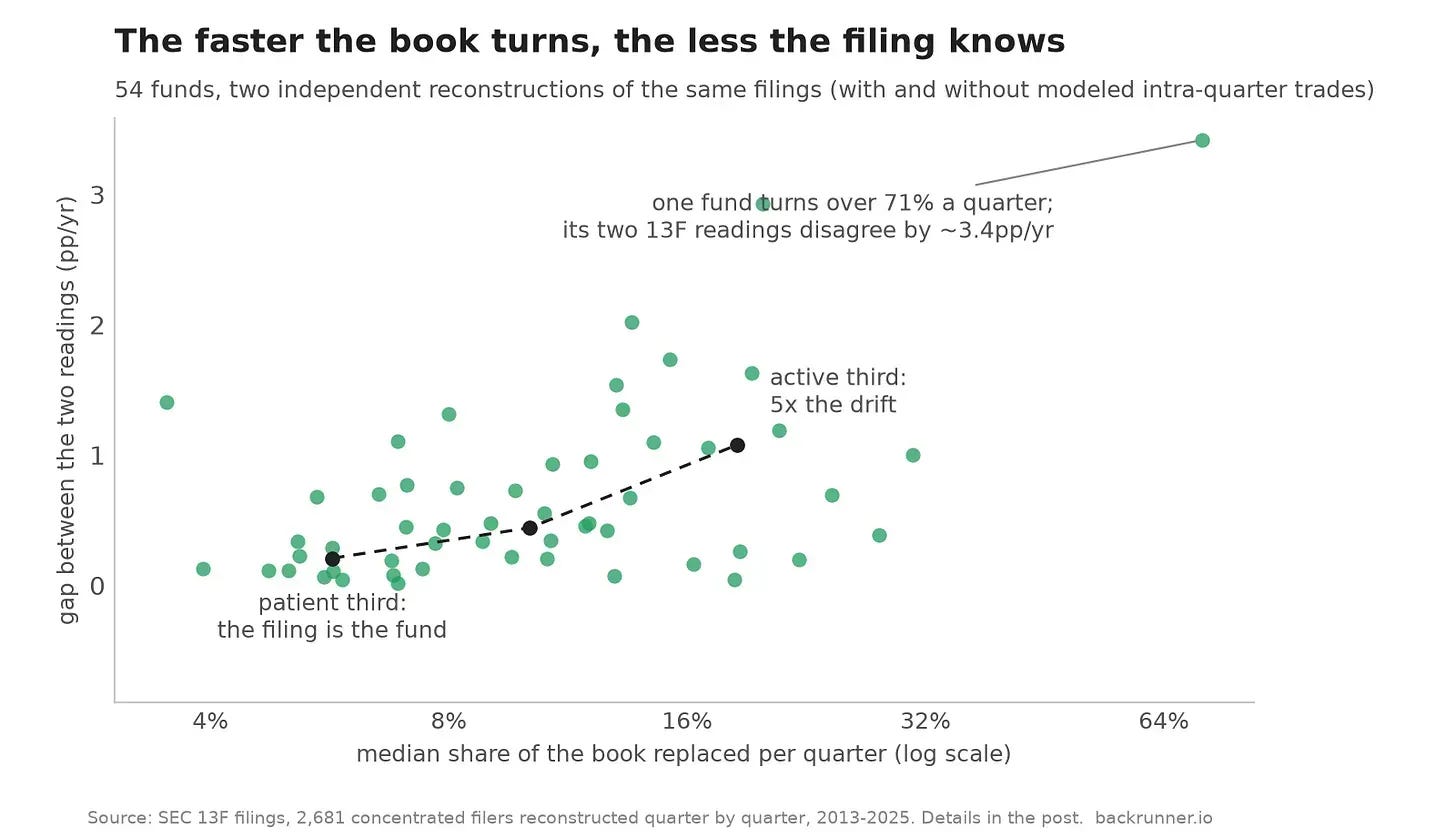
I can put a number on that blindness. For 54 of the reconstructed funds I have a second, independent reconstruction that does model intra-quarter trading (at assumed mid-quarter prices).
For the most patient third of those funds, the two lenses agree almost perfectly: same quarterly returns to within 0.05 points, correlation 0.998.
For the most active third the disagreement is five times wider, and at the extreme, a fund turning over 71% of its book every quarter, the two views of the same filings drift apart by about 3.4 points a year.
And both views are built from the same filings, so even that gap is a floor, not the full leak. Past a certain turnover, “this fund’s 13F performance” stops being a fact and becomes a guess with widening error bars.
So when I exclude high-turnover funds from everything that follows in this series, hear it correctly: it is not a judgment about their skill. It is an admission about the 13F limitations as an instrument.
The lag and the lens fail on exactly the same funds, the unreadable ones, and spare the patient, concentrated ones, which, after last post’s findings, are the only kind with any claim on your attention anyway.
The leaks nobody prices
So if the famous leak is a rounding error, why did the follower lens in my reconstruction still come out slightly behind the funds themselves, 24.8% versus 25.3% beating the index, a median drag of about a third of a point?
Because the copy leaks in quieter places, and those do not show up in any spreadsheet until you have tried the strategy and experienced them.
You inherit positions without theses. The filing tells you what a manager owns, never why, at what basis, or with what exit in mind. So the first 20% drawdown arrives, and you have no way to know whether the manager is adding or already gone. Borrowed conviction expires precisely when conviction is the only thing that would keep you in.
This is the largest leak in copy-trading, it is behavioral, and the individual-investor evidence (the Barber and Odean literature on how retail accounts actually trade) says it compounds: people sell the inherited winner and average down the inherited loser.
The book you see is not the book they run. No shorts, no swaps, no foreign lines, no cash. A position that looks like a bold conviction bet can be one leg of a hedged pair whose other side is invisible by law. You copy the leg, not the trade.
Some of what you see is already gone. Beyond the intra-quarter blindness we just priced, anything sold in the 45 days between quarter end and filing day is a ghost you may be buying at the very moment its seller is done with it. For patient funds this is rare, one more way the same discipline that makes a fund followable makes its filing honest.
The sizing is yours to fumble. The manager’s 6% position sits inside a book with risk controls, offsetting exposures and an investment committee. Your version of it sits inside a five-stock brokerage account next to your emotions. Same ticker, entirely different risk level.
Add it up and the arithmetic of the whole enterprise inverts.
The copy machinery, lag included, leaks a few tenths of a point a year. The funds being copied trail the index by 2.8 at the median.
Which brings us to the actual question
Following one fund fails at the selection step, before the copy even starts, and no copying technique fixes that.
But notice what this post quietly established along the way: for patient, concentrated managers, the public filing IS the portfolio, at essentially no cost to a follower. The data is a nearly lossless window into how the most disciplined stock pickers in the country are actually positioned, six weeks late.
Which raises a better question than “which manager do I copy?”
But I propose a different approach.
What happens if you stop copying anyone in particular, and instead follow what many disciplined managers agree on at the same time? That question has an academic literature, a twenty-year answer, and an honest catch.
And I will cover it in the next post.
Frequently asked questions
Does the 45-day filing lag make 13F data useless? Measured properly, no. Holding a fund’s book one quarter stale costs the median fund copier about zero points a year; it only becomes expensive (about 0.6 points) for high-turnover funds, whose filings cannot show the intra-quarter trading their strategy actually lives in.
Can I tell from a 13F when a fund actually bought or sold? No. Filings are quarter-end snapshots. Trades inside the quarter are invisible, and a position sold after quarter end still appears in the filing. Prices paid and timing are never disclosed.
So is copying individual trades from filings a good idea? The evidence says no, but not because of the lag: the funds themselves mostly trail the index, winners do not repeat reliably, and a copier inherits positions without the thesis or the exit. Filings work better as a map of where disciplined investors agree than as a trade feed.
Next in the series: the research. What two decades of academic work found when it followed filings in baskets instead of heroes, what my own replication says, and the honest catch that most write-ups leave out.
Not investment advice. Do your own research.