
Which 13F funds should you follow? Not last year's winners.
Chasing hot funds doubles your downside. Adding more funds adds nothing. What actually marks a followable fund is boring but works.

45 Days Late #4. Post 3 ended on the question every academic paper about following filings quietly skips: they all assume you already know which managers deserve your attention. This post is what happened when I stopped assuming and tested it.
Here is the uncomfortable math from the earlier posts. The consensus basket works on a curated universe of about 80 concentrated, patient filers. The full field contains 2,170 measurable candidates. So somebody, somehow, has to pick the 80, and post 1 already proved the obvious method is broken: past performance does not identify future winners, because winning does not persist. Only losing does.
I tested the three ways people actually try to build the list. Two of them are traps.
Trap one: follow the leaderboard
The most natural idea in the world: rank all funds by their last three years against the index, follow the top 80, refresh the list every year, kick out the laggards.
I expected it to underperform. It did something more interesting.
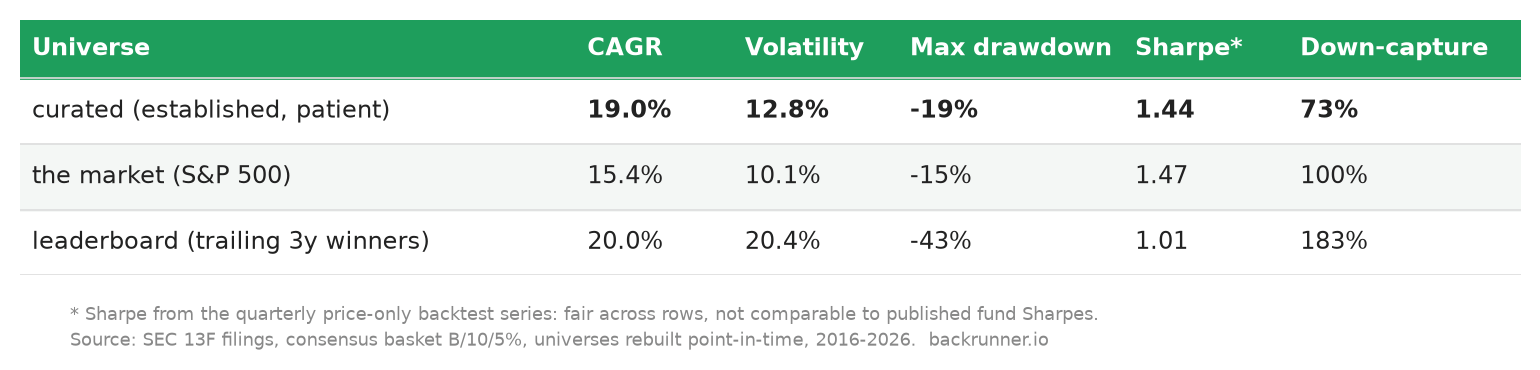
It made more money than the curated universe: 20.0% a year against 19.0%, over 2016-2026.
But there is but.
When the market fell, as it periodically does, the leaderboard universe fell 183% as hard, nearly double the market’s own drawdowns, against 73% for the curated set.
Its worst peak-to-trough loss was 43%, in a decade where the market’s was 15%. Its Sharpe ratio, the return-per-unit-of-risk number, came out 1.01, worse than just buying the index and going outside.
One extra point of annual return, purchased with double the volatility and triple the drawdown.
The mechanism is worth spelling out.
Ranking by recent performance does not select for skill; post 1 showed skill barely persists.
It selects for whatever style is currently hot. You end up following the funds most levered to the recent regime, which means you arrive at every party exactly when the music is loudest. The leaderboard is a cursed momentum bet.
And a detail I did not expect: it does not even matter how you churn the list. I ran the annual refresh two ways, forced replacement and replace-only-if-better. They produced identical universes. Fresh winners always outscore decayed incumbents, so the leaderboard replaces its whole bottom every year like clockwork. The list never stabilizes, because “recently hot” is not a stable property of anything.
Trap two: skip the choosing, follow everyone
If picking is hard, why pick?
Take every fund that passes the basic shape bar and let the consensus mechanism sort it out. Diversification of stock pickers, the same logic that makes index funds work. I ran the basket on universes growing from the curated ~80 all the way out to 482 funds.
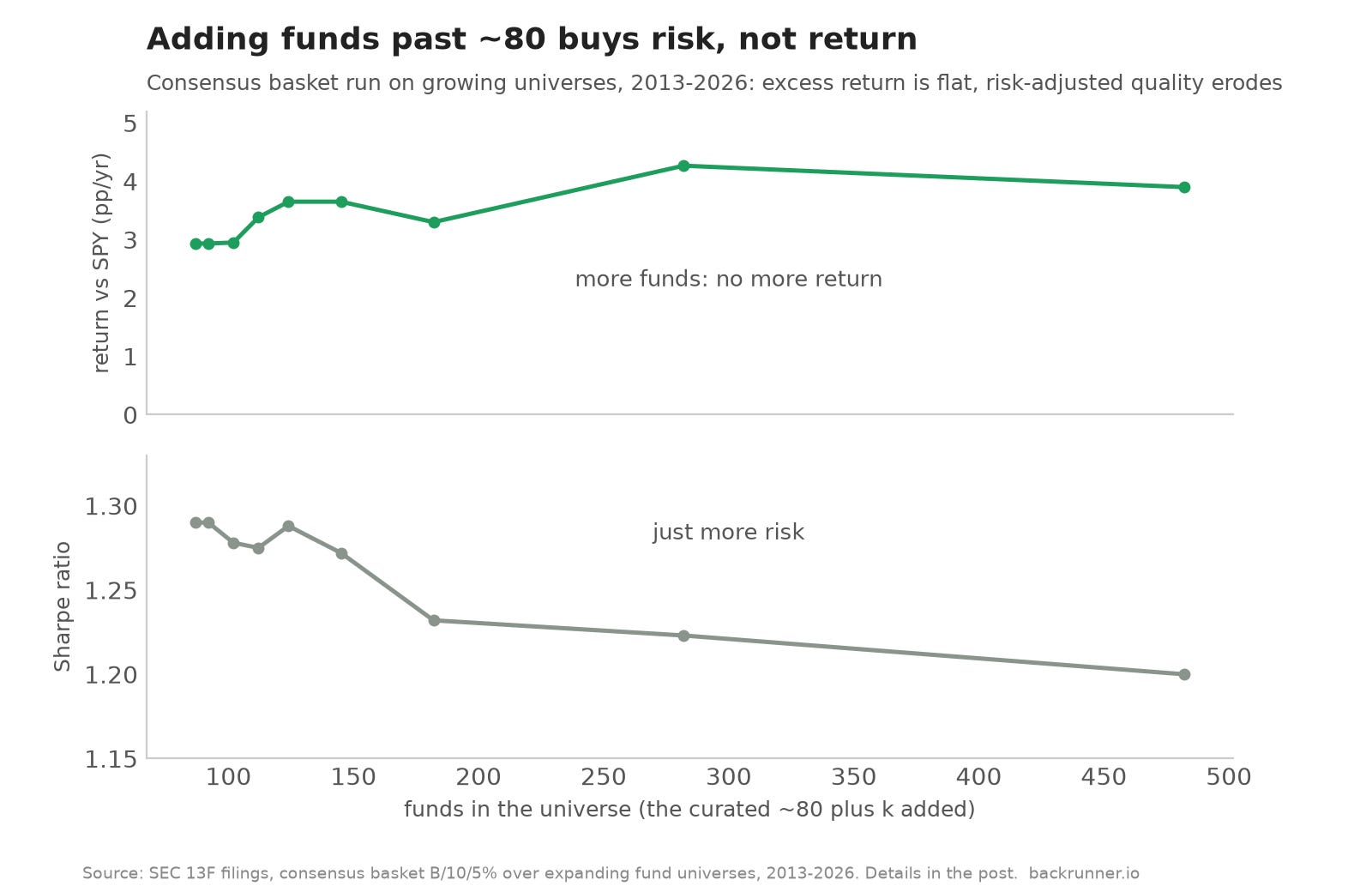
The return edge does not improve.
It wobbles between +3 and +4 points a year whether the basket listens to 87 funds or 482. By 80 funds the signal is saturated, and every fund after that mostly adds noise votes that degrade the risk profile. Sharpe declines monotonically as the universe grows.
More opinions past a point just means more mediocre opinions.
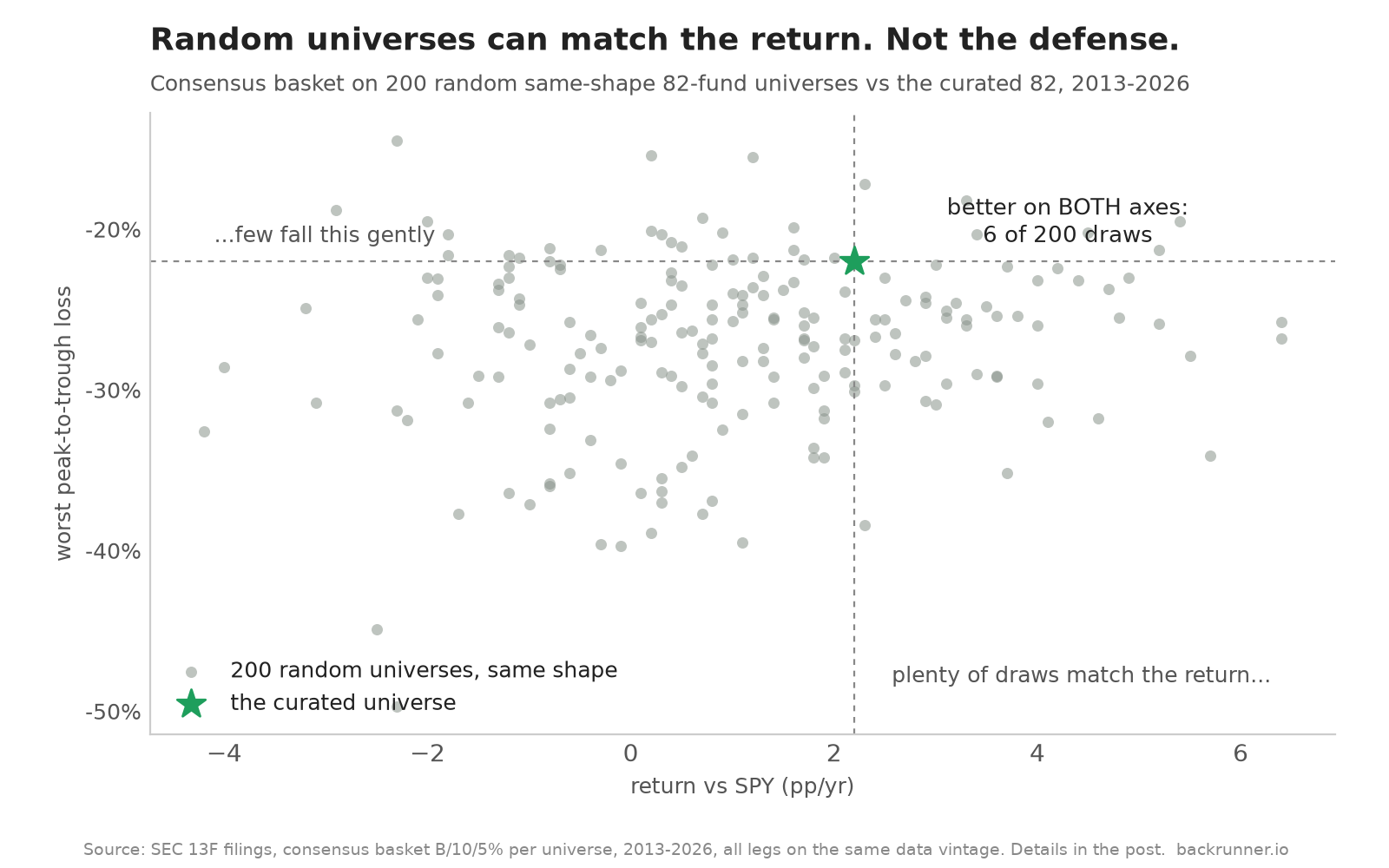
I also ran the reverse test. Take 300 random draws of 82 funds from the qualified field and run the basket on each. The random universes averaged about a point below the index. Some got lucky on return; 3.7% of the draws beat the curated universe’s return. But essentially none, 0.7%, matched its risk-adjusted quality. Random gets you the occasional hot streak. It almost never gets you the thing that makes the strategy holdable through a bad year.
So what actually separates the followable funds?
Not genius, and by now that should be no surprise.
When I compared what the curated universe’s basket did against the random ones, the difference was not the upside at all: it captures 109% of the market’s rallies, roughly what the random baskets do.
The difference is that it falls only 91% as hard as the market when things break, while random universes fall 116%. Same offense, better defense, quarter after quarter.
The moat is not brilliance. It is not blowing up.
Where does the defense come from?
I went looking for it in the funds’ observable paperwork, and it turns out followability has a legible signature:
funds that are established (a decade-plus of filings),
sizeable,
concentrated, and
patient.
A simple model built on those traits, trained on half the curated list, identifies the other half in years it never saw with an AUC of 0.81, which for a returns-free screen on public filings is remarkably strong.
The same structural traits that make a fund’s 13F readable (concentration, patience, the things posts 1 and 2 kept running into) also mark the funds worth reading. Discipline does the work.
Two honest limits.
First, the signature narrows the field, but it does not finish the job. “Established and concentrated” describes defensive compounders and aggressive high-beta funds alike, and the model cannot yet tell them apart. Some judgment about how a manager behaves in a drawdown still sits on top.
Second, the caveat from post 3 still applies to everything here: even the curated basket’s edge is a style the market has been rewarding, not conjuring. But we will get to that in couple of posts in this series.
The list is chosen. Now what?
You now have the whole selection argument in one place: leaderboards buy you double downside, breadth buys you nothing, and the durable markers are structural, which is why the universe I actually track is built on establishment, concentration and patience rather than on anyone’s recent scoreboard, and gets reviewed against those same markers rather than against last year’s returns.
But a chosen universe is just a reading list. Eighty disciplined managers still hold hundreds of different stocks, disagree with each other constantly, and cannot all be right.
The next question is the mechanical heart of this whole series: how do you turn eighty careful books into one signal, without trusting any single one of them? That answer has a name, it is the reason this project exists, and it gets the next post to itself.
Frequently asked questions
Should you follow the best-performing 13F funds? The data says no. A universe of trailing 3-year winners, refreshed annually, returned about one point a year more than a curated universe over 2016-2026 but fell nearly twice as hard as the market in drawdowns (183% down-capture vs 73%), with materially worse risk-adjusted returns. Recent performance selects for hot styles, not persistent skill.
Is it better to follow more funds? Past roughly 80 well-chosen funds, no. In my tests the consensus basket’s excess return stayed flat between +3 and +4 points a year as the universe grew from 80 to 482 funds, while the Sharpe ratio declined steadily. The signal saturates; extra funds add noise.
What makes a fund worth following in 13F filings? Structural discipline rather than recent results: a long filing history, meaningful size, a concentrated book, and low turnover. Those traits identified held-out curated funds with an AUC of 0.81 in our tests, and they are the same traits that make a fund’s quarterly filings an accurate picture of what it actually does.
Not investment advice. Do your own research.
Stay disciplined, resist the FOMO. Just like the best in the business.