

45 Days Late #5. The series so far: most funds lose to the index and winners do not repeat (post 1), the 45-day lag is nearly free for patient funds, choosing whom to copy is the real problem, the research answer is baskets over heroes (post 3), and the universe worth listening to is defined by discipline, not recent wins (post 4). One piece is missing: how eighty careful books become one signal. This is that post.
Eighty disciplined managers is still eighty different opinions. In their most recent quarter, the concentrated funds I track held over two thousand distinct stocks between them. Any method that starts with “just buy what they own” fails immediately.
The whole game is compression: from a couple thousand names down to the handful actually carrying information, without trusting any single manager’s judgment, including the best one.
The compression method I landed on runs on one idea, and everything in the earlier posts was building the case for it: independent agreement between people who are expensive to convince.
Why agreement, of all things
Recall the one robust positive result in the research from post 3: the Best Ideas finding.
Managers’ skill, where it exists, is not thinly spread across their books.
It concentrates in the few positions they size like they mean it. A 5%+ position in a 25-stock fund is a statement made with real money.
The 40th name with 0.2% of AUM in a padded book is furniture.
So the first cut is brutal: a stock only counts for a fund at all when it is at least 5% of that fund’s disclosed book. Conviction or nothing.
But post 1 taught us a single manager’s conviction, however sincere, is an anecdote. Managers are wrong constantly, and you cannot tell in advance which ones will be right this time. That is the whole reason hero-copying fails. What you can do is ask a different question: how often do several concentrated books, run by managers who mostly do not know each other, each independently decide the same stock deserves a serious slice of their capital at the same time?
The answer, empirically, is almost never. That is what makes it a signal.
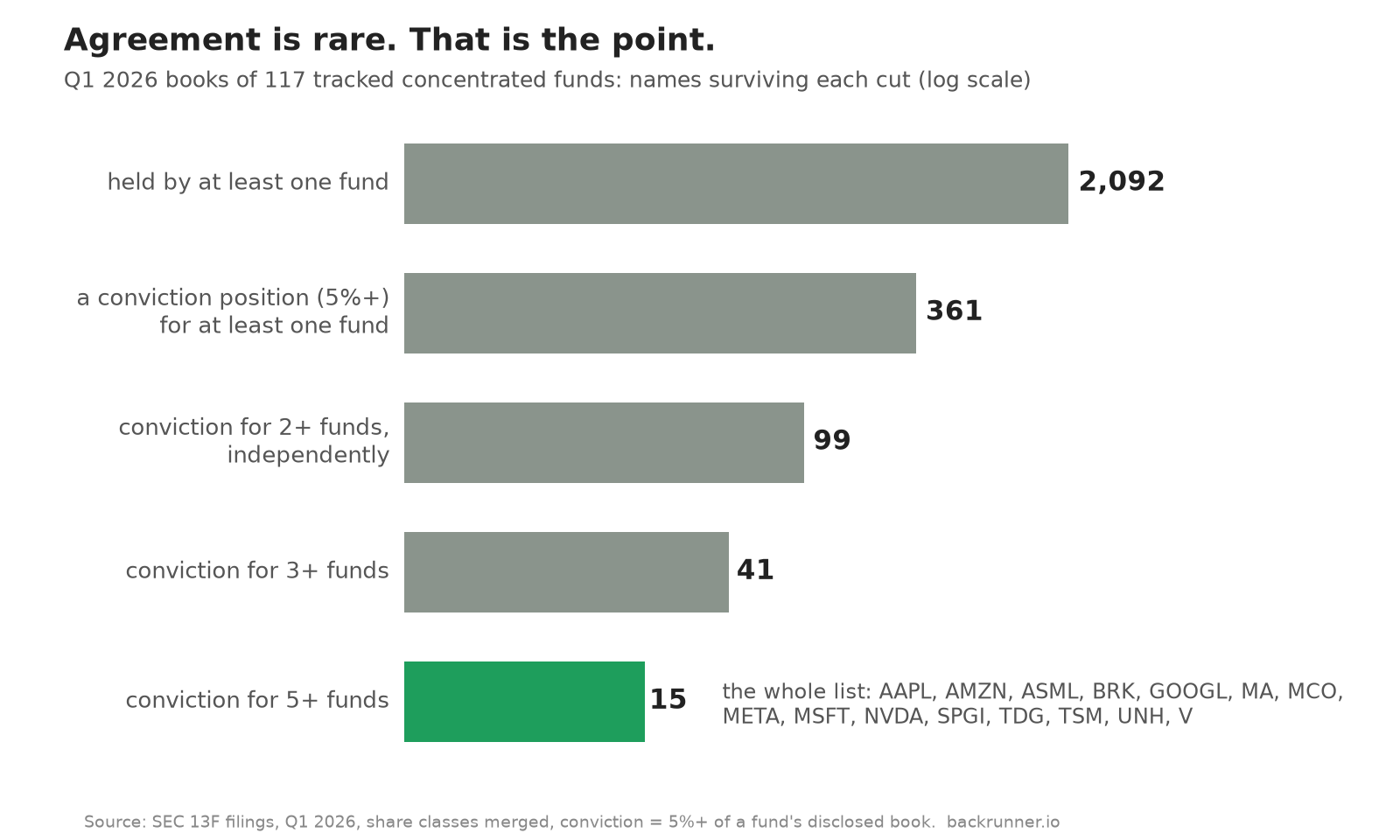
Take the most recent reported quarter. The tracked funds books held 2,092 names between them. Require a name to be a conviction position for even one fund: 361 left. Require two independent conviction holders: 99. Three: 41. Five or more: 15 stocks, out of two thousand! In a good quarter this last group fits on an index card, and it changes by a name or two per quarter, not by wholesale turnover.
Deep agreement among concentrated books is genuinely rare, which is exactly what you want from a filter. A signal that fires constantly is a fire alarm with a dead battery. This one fires almost never. When it does, several disciplined investors have each put a meaningful share of their fund behind the same idea. They answer to different clients, run different processes, and cannot copy each other’s homework in advance (hopefully).
The rules
The basket from post 3 is just this idea made into a ruleset. Every rule kills one specific way the signal gets polluted:
Conviction threshold (5% of the book). Kills furniture. A fund’s 69th-best idea is not information, per Best Ideas above.
Two consecutive quarters to count. Kills ghosts. A position that appeared in one filing may already be gone by the time you can act (the post 2 leaks). A vote only counts once the position has sat through two quarter-ends.
Share classes merged, one vote per issuer. Kills double counting. GOOG and GOOGL are one opinion, not two.
Each manager’s influence capped. Kills gurus. No single fund, however famous, can drive a name into the basket on its own. Agreement means several someones, definitionally. A single vote from Berkshire is great in both credibility and dollars weight. But I believe everything is relative. $100 million from Buffet is not the same as $100 million from someone with $500 million in AUM.
Rank by number of independent conviction holders and hold the top 10. The signal itself. Depth of agreement decides membership, nothing else.
A name stays until the agreement dissolves. Kills churn. Entry is hard, and exit only happens when the funds themselves walk away. The basket does not fidget. In the backtest one name sat in the basket 51 of 52 quarters.
Everything happens ~52 days after quarter close. The lag, priced honestly: the earliest date a real follower could realistically act, which post 2 showed costs a patient basket approximately nothing.
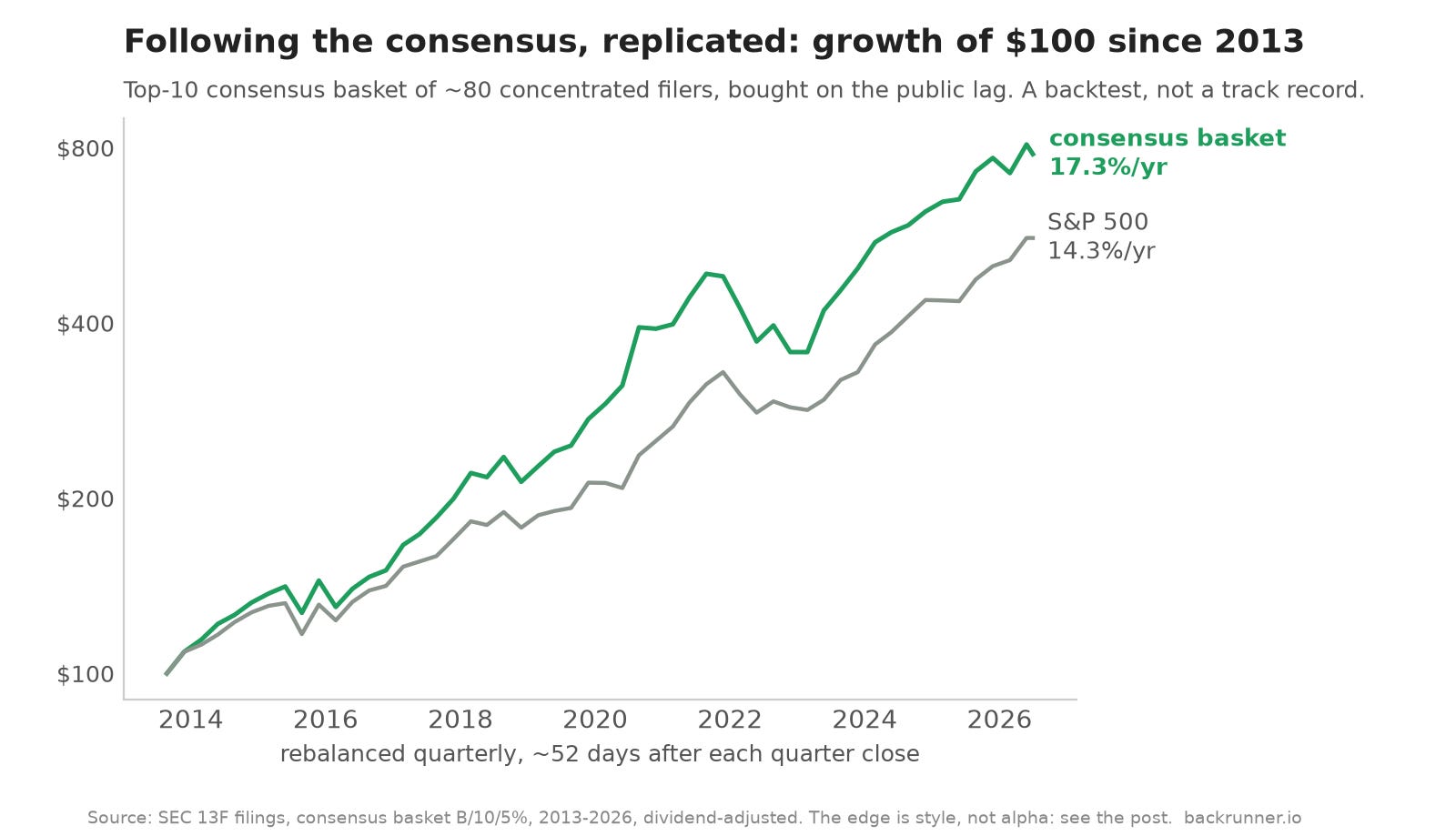
Run those rules quarter after quarter since 2013 and you get the result from post 3.
Here is the full risk picture, both legs measured identically from the same quarterly series:
Both legs measured identically, quarterly, price-only, 2013-2026.
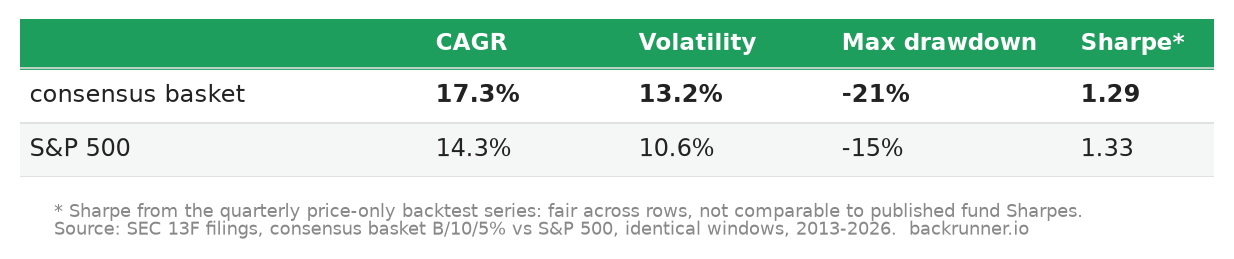
The honest reading takes the table whole. The basket compounds 3 points faster. Behind those rows sits an asymmetry: it captures 112% of the market’s rallies and only 87% of its falls. It also runs hotter than the index, and in a decade this strong the index’s own Sharpe ends a touch higher. The caveat from every previous post is not going away either. Attribution says this edge is a harvested style, not stock-picking magic.
What agreement looks like right now
The fifteen names with five-plus independent conviction holders last quarter: Apple, Amazon, ASML, Berkshire, Alphabet, Mastercard, Moody’s, Meta, Microsoft, Nvidia, S&P Global, TransDigm, Taiwan Semiconductor, UnitedHealth, Visa.
Read that list slowly, because it is the least surprising list in finance. This is the honest texture of what concentrated smart money agrees on: wide-moat, cash-gushing, large-cap compounders. No lottery tickets, no secret microcaps. Anyone hoping consensus would reveal hidden treasure will be disappointed. Concentrated managers agree on quality so obvious everyone already knows its name. Whether being told “own the obvious compounders, hold them for years” is trivial or is the entire hard part of investing, I leave to anyone who has actually tried to hold a position through a 30% drawdown.
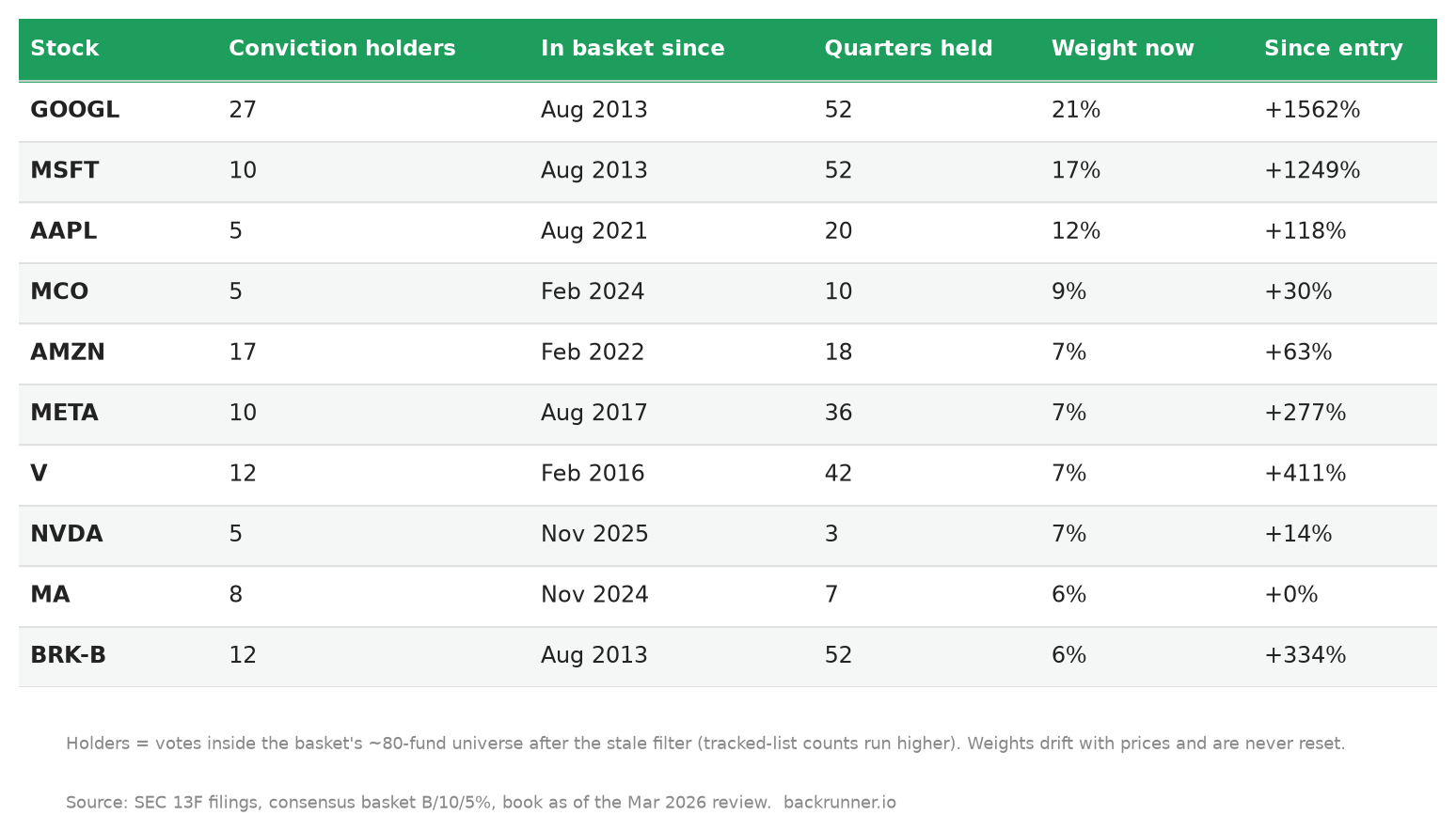
The basket distills that agreement down to ten names. Here is its current book, with the drift left visible:
And the names at the door:
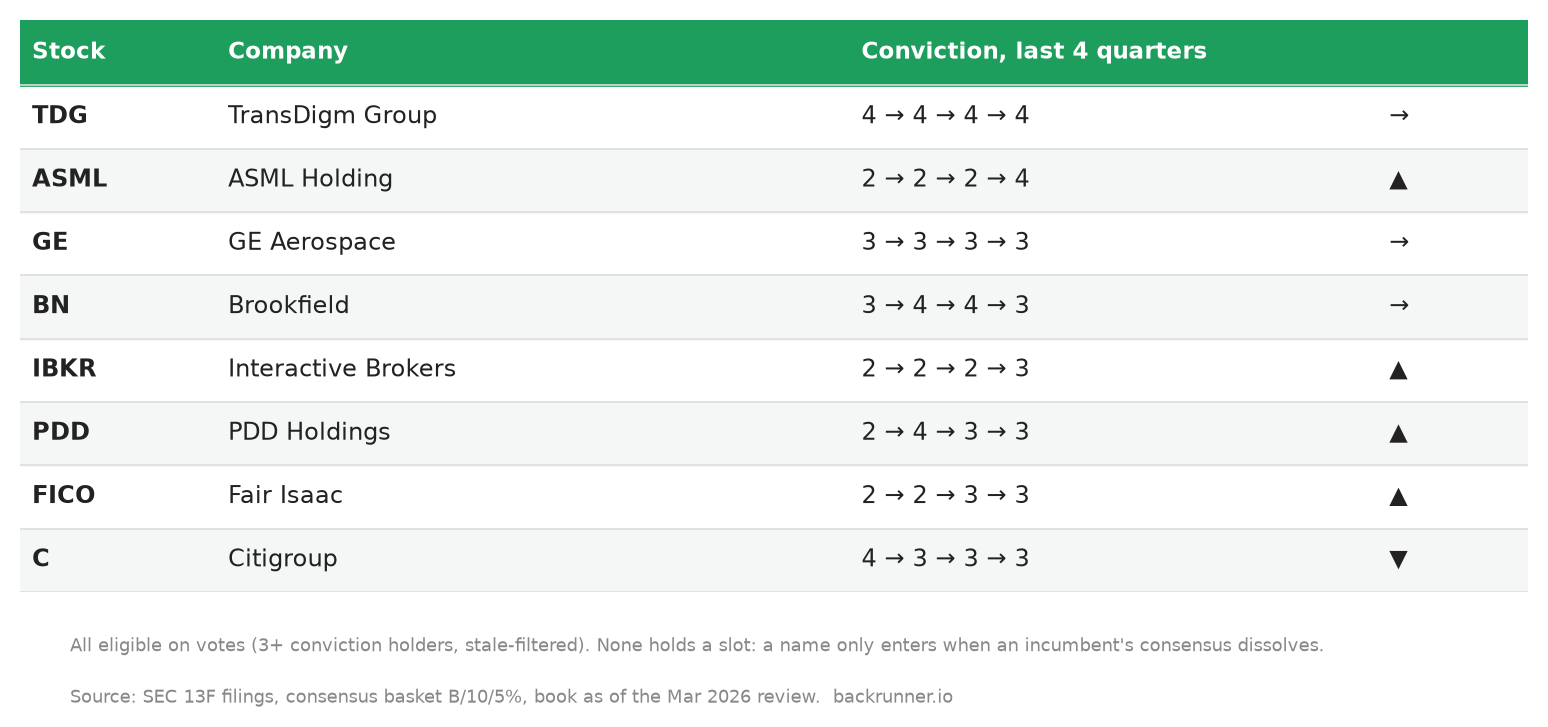
I keep this view rebuilt every quarter, for every tracked name with the full holder detail, on backrunner’s consensus explorer. It is the screen I check first when new filings land, precisely because it moves so little. When the index card changes, something real happened.
Frequently asked questions
What is a 13F consensus basket? A rules-based portfolio of the stocks that several concentrated fund managers independently hold as high-conviction positions (5%+ of their book) at the same time, with membership reviewed quarterly after 13F filings become public. Holdings are never rebalanced back to target weights. Positions trade only when the agreement itself changes. Depth of independent agreement, not any single manager’s opinion, decides what qualifies.
Why require agreement between multiple funds? Because single-manager conviction does not persist reliably. Past winners beat the index at roughly a coin flip. Requiring several independent concentrated books to back the same name filters out both individual error and portfolio furniture. Empirically the filter is severe: of about 2,100 names held by tracked funds in Q1 2026, only 15 had five or more independent conviction holders.
Doesn’t everyone already know these consensus stocks? By name, yes. The current list is dominated by mega-cap compounders. The information is not the names but the structure: how many independent disciplined managers commit serious capital, how that agreement shifts quarter to quarter, and the discipline of holding a small, slow-changing basket through drawdowns. The tested edge, to be clear, is a style tilt harvested with discipline, not secret knowledge.
What’s next?
This post concludes the main idea that I wanted to deliver. 13F is an incredibly interesting dataset rich with insights. Over last 5 posts I’ve shown how the edge can be extracted just from aggregating the data in a reasonable way. No data-mining. Just logic.
But there is much more to 13F and I’ve built a tool to show this. It’s called backrunner as a callback to the fact that we, as retail investors run after the main money managers made their moves. Which as I showed earlier doesn’t mean the information is not useful anymore.
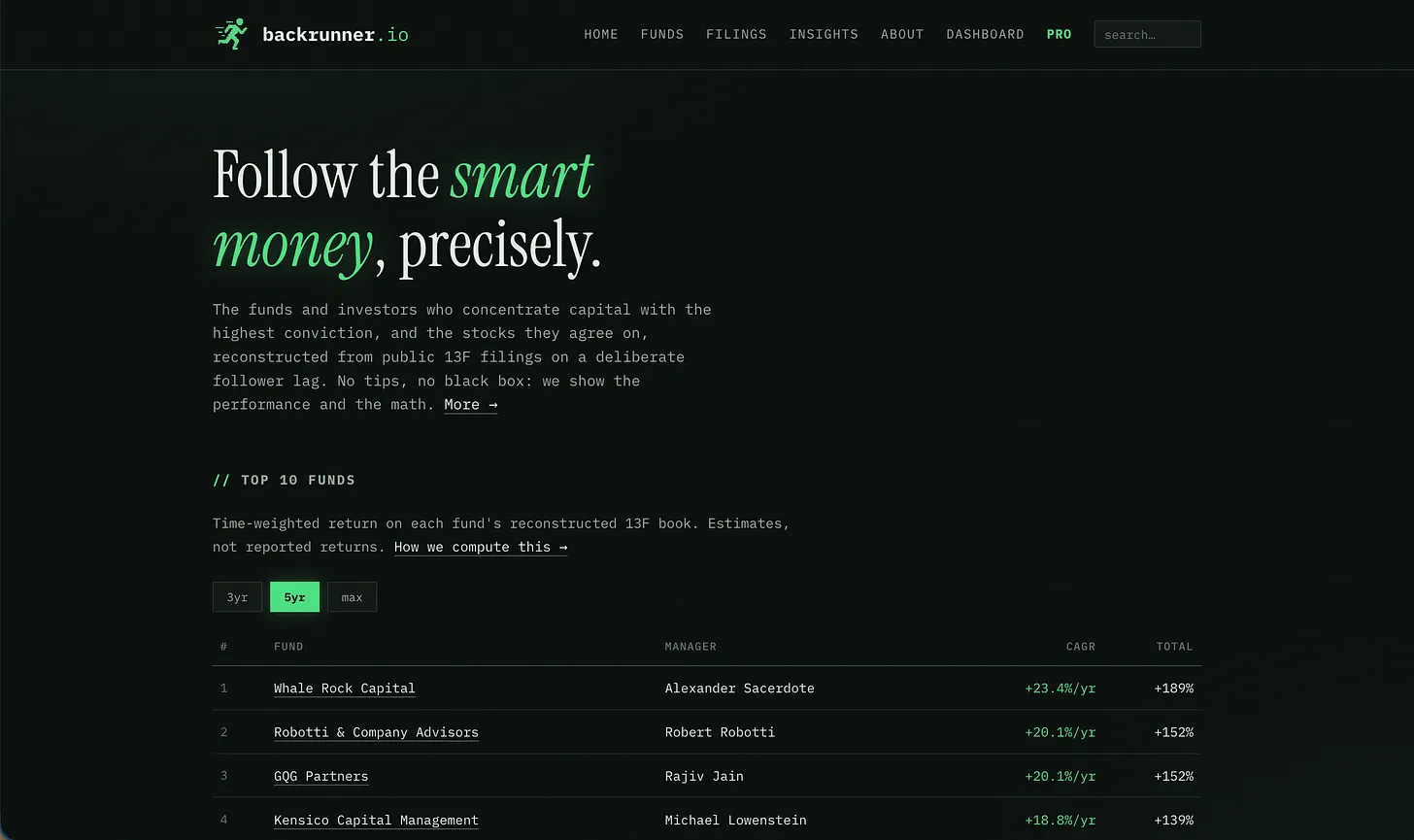
Backrunner shows the funds I consider worth following. Shows how consensus is behaving. Shows individual stocks and provides valuable insights that you can use in your own investing when analysing stocks.
There is a lot more to show. And I have couple of subjects I am currently working on:
How basic consensus basket performance can be improved with fundamentals
How single stock consensus is predictive of it’s performance
How retail investors can use 13F data to improve their analysis
And most importantly - we are nearing the end of the Q2 2026 filing window, so we will see how top investors view the current market developments with all the AI and geopolitical volatility. Are we getting closer to a bubble popping or smart money choose to double-down?
If you want to support the backrunner blog - consider subscribing to this newsletter. It’s free and is a decent place for open data-driven discussion.
Not investment advice. Do your own research. Don’t let the FOMO eat you alive.